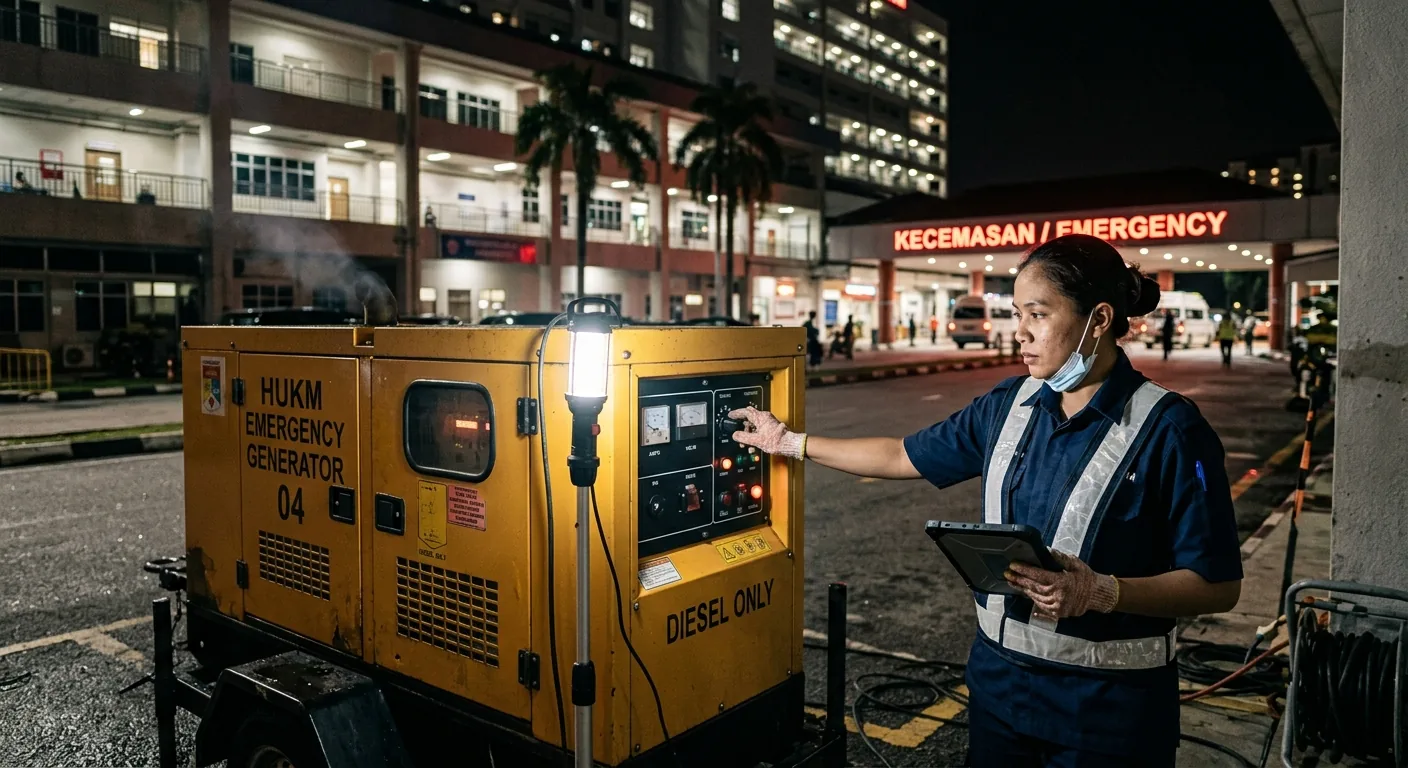
Genset safety starts with siting the unit in an open, well-ventilated area (never inside a building, because carbon monoxide fumes can be fatal), keeping a minimum clearance of 3–6 metres from walls and windows, proper earthing, refuelling only when the engine is cool, having a fire extinguisher ready, and never overloading beyond the unit's kVA capacity. Always refer to the unit's manual.
A diesel genset is safe to operate — as long as you follow the basic procedures. Most genset accidents (CO poisoning, fire, electric shock) come from poor placement and carelessness during refuelling, not from a faulty unit.
Why are ventilation & carbon monoxide (CO) the most critical?
Because CO is a silent killer — odourless, colourless, and capable of being fatal within minutes in an enclosed space. This is the number-one genset safety risk, so the unit must be placed in an open area, never inside a house, garage, basement or closed tent.
Diesel exhaust fumes contain carbon monoxide that builds up quickly in spaces with no airflow. Even with a garage door half open, the gas can still get trapped and drift back into occupied areas.
Make sure the exhaust points well away from doors, windows and building air intakes. For indoor projects, proper exhaust ducting is essential — talk to us before delivery.
- Place the genset outdoors, in an open, fully ventilated area
- Never install it in an enclosed or semi-enclosed space
- Direct the exhaust pipe away from windows, doors & vents
- Fit a CO alarm if people are nearby continuously
- Stop using it immediately if you feel dizzy, nauseous or queasy
| Location | Safe? |
|---|---|
| Open area under a canopy roof | Yes |
| Inside a garage / store | No |
| Basement / small room | No — CO hazard |
| Beside a bedroom window | No |
How far should a genset be from buildings & why earthing matters?
A safe clearance is roughly 3–6 metres from walls, windows and flammable materials — the larger the kVA, the more distance the better. This keeps exhaust heat, vibration and fumes from drifting back into the building.
Earthing (grounding) is mandatory to prevent electric shock in case of a current leak. Large gensets need to be connected to a buried earthing rod, not just stood on the ground.
Set the unit on a flat, firm and dry surface. Avoid muddy or sloping ground that can cause the unit to vibrate or spill fuel.
- Clearance of roughly 3–6m from walls & flammable materials
- Earthing/bonding is mandatory — use an earthing rod for large units
- Flat, firm, dry surface — not soft or sloping ground
- Make sure the circuit has an ELCB/RCD for added protection
- Don't place it under dry trees or near fuel storage
| Item | Safe guideline |
|---|---|
| Clearance from building | Roughly 3–6 metres |
| Earthing | Mandatory — buried earthing rod |
| Surface | Flat, firm, dry |
| Circuit protection | Fit an ELCB/RCD |
When & how to refuel a genset safely?
Refuel only when the engine is COOL and switched off — never top up while the engine is running or hot. Diesel spilled onto hot parts can ignite instantly.
Wait about 10–15 minutes for the engine to cool after shutdown before opening the tank. Use a funnel and avoid overfilling; spilled diesel is slippery and flammable.
Always keep a dry-powder (DCP) or CO2 fire extinguisher nearby. Don't smoke and avoid open flames within the fuel storage radius.
- Switch off the engine & let it cool before refuelling
- Use a funnel; don't overfill
- Wipe up any diesel spill immediately
- Keep a fire extinguisher (DCP/CO2) nearby
- No smoking or open flames while refuelling
| Refuelling step | Action |
|---|---|
| Before filling | Switch off engine, let cool 10–15 minutes |
| While filling | Use a funnel, don't overfill |
| If spilled | Wipe up immediately, avoid flames |
| Have ready | DCP or CO2 fire extinguisher |
How to avoid overload & stay safe in bad weather?
The main cause of overheating and tripping is overload — total load exceeding the unit's kVA capacity. The safe approach: add up all your loads (load list) and choose a genset with spare margin so it never runs at 100%.
Gensets typically range from 20kVA–500kVA+; the actual size depends on your equipment, so confirm with a load list before booking. Contact us for the right size estimate.
In the rain, protect the unit with a VENTILATED canopy or tent (not fully enclosed) so water stays out but fumes can still escape. Never operate a genset with wet hands or on a wet floor.
- Add up your loads (load list) — don't run at 100% load
- Choose a kVA with spare margin for motor start-up
- Shelter from rain with a ventilated canopy, not enclosed
- Don't touch controls with wet hands/wet floor
- Stop & inspect if the unit overheats or trips often
| Factor | Safe action |
|---|---|
| Overload | Pick a kVA with margin; don't run at 100% load |
| Rain | Ventilated canopy; keep water out |
| Lightning/flood | Switch off & disconnect |
| Unit size | Confirm via load list — roughly 20kVA–500kVA+ |
- Place the genset outdoors in a ventilated area — CO in an enclosed space can be fatal within minutes.
- Keep a clearance of roughly 3–6m from buildings; earthing is mandatory to prevent shock.
- Refuel only when the engine is cool & off — diesel on hot parts ignites easily.
- Don't overload: add up your load list & choose a kVA with spare margin.
- Keep a fire extinguisher ready and shelter from rain with a ventilated cover.
Contact Us Now — Reply Within 1 Hour
Genset safety guide: CO ventilation, clearance, earthing, refuelling, fire extinguisher & overload. Full checklist. WhatsApp us for safe genset rental.
WhatsApp NowFAQ
Can I run a genset inside the house or garage?
No. Genset fumes contain carbon monoxide that builds up in enclosed spaces and can cause death. The genset must be placed outdoors, in an open and fully ventilated area, with the exhaust directed well away from windows and doors.
What is the safe distance for a genset from a building?
Roughly 3–6 metres from walls, windows and flammable materials — the larger the kVA, the more distance the better. This keeps heat, fumes and vibration from drifting back into the building.
Is it safe to refuel a genset while the engine is running?
No. Switch off the engine and wait about 10–15 minutes for it to cool before topping up. Diesel spilled onto hot parts can ignite instantly, so use a funnel and avoid overfilling.
How do I know the right genset size so it doesn't overload?
Add up all the equipment you plan to run (load list) and choose a unit with spare margin so it never runs at 100% load. The typical range is 20kVA–500kVA+; contact us for the right size estimate and a quote.
Does a genset need earthing?
Yes, earthing (grounding) is important to prevent electric shock if a current leak occurs. Large units should be connected to a buried earthing rod, and the circuit is best fitted with an ELCB/RCD.
Can I run a genset in the rain?
Yes, but the unit must be protected with a VENTILATED canopy or cover — not fully enclosed — so water stays out but fumes can still escape. Never operate a genset with wet hands or on a wet floor.