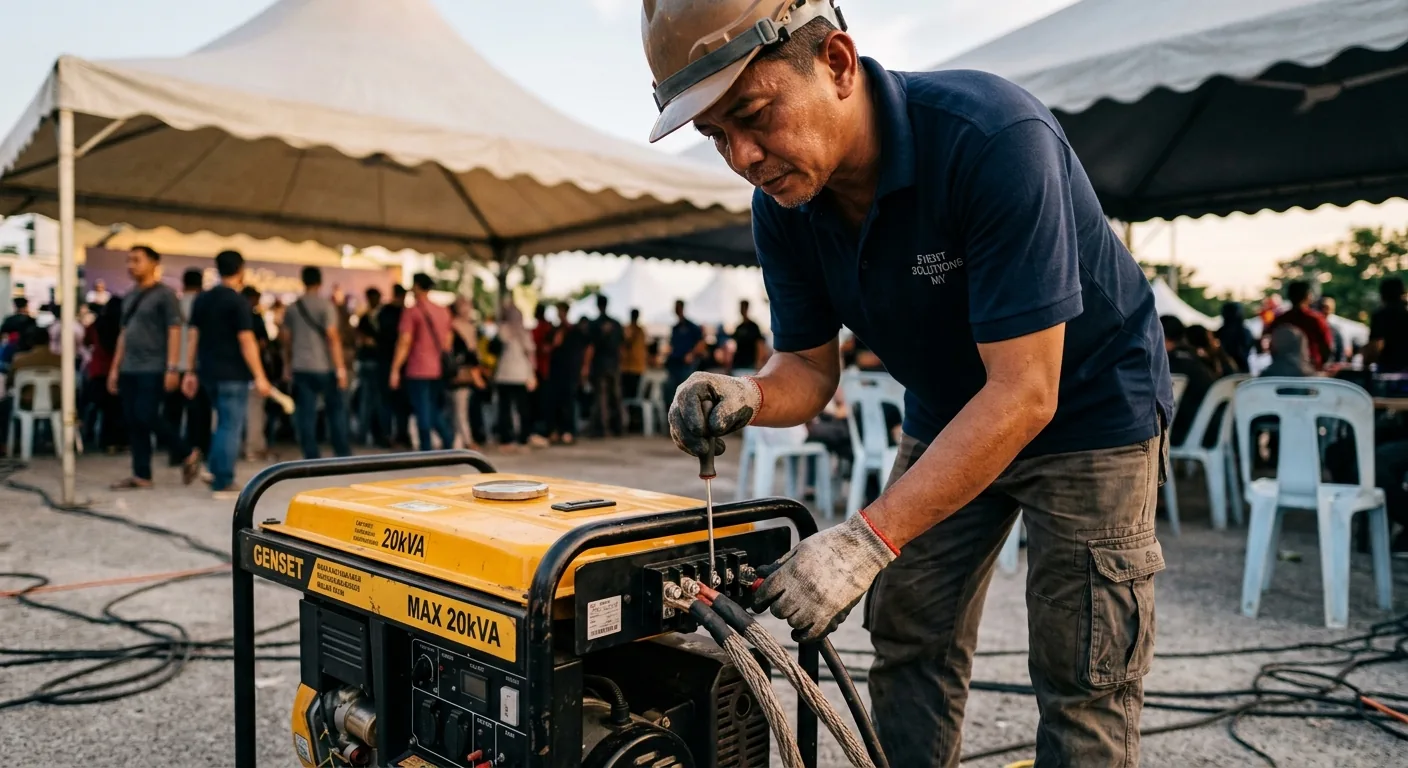
A genset works when its diesel engine burns fuel to spin an alternator, which converts mechanical energy into electricity. The AVR keeps the voltage stable, while the ATS and auto-start fire the genset up automatically within seconds the moment your TNB supply is cut.
When your main supply suddenly goes down, a genset becomes the saviour — yet many people have no idea what actually happens inside the unit. The process is easy to understand, and knowing it helps you pick the right size.
How does a genset work from A to Z?
A genset works by converting mechanical energy into electrical energy through two core components: the diesel engine and the alternator.
The diesel engine burns fuel to produce rotation. That rotation is coupled directly to the alternator, and it is the alternator that generates the electrical current fed to your load — whether that's lights, air conditioning, factory machinery or site equipment.
Throughout this process, several support systems work in tandem: the control panel monitors the readings, the AVR stabilises the voltage, and the fuel system keeps the diesel flowing. All of it happens in a matter of seconds.
- The diesel engine starts and produces mechanical rotation
- The rotation spins the alternator (the actual electricity generator)
- The alternator converts mechanical energy into AC electricity
- The AVR stabilises the voltage before it reaches the load
- The control panel monitors and protects the entire system
| Step | What happens |
|---|---|
| 1. Engine | Burns diesel, produces rotation |
| 2. Alternator | Rotation becomes AC electricity |
| 3. AVR | Stabilises the output voltage |
| 4. Load | Electricity delivered to equipment |
What do the diesel engine and alternator do?
The diesel engine is the power source, while the alternator is the electricity generator — both are linked on one and the same shaft.
The diesel engine works much like a car engine: it burns diesel inside the cylinders to produce continuous rotation. This rotation is measured in RPM and held steady (typically around 1500 RPM for a 50Hz Malaysian genset) so that the frequency of the electricity generated stays correct.
The alternator, in turn, contains coils and a magnetic field. When the engine shaft turns it, the moving magnetic field produces an electrical current through electromagnetic induction. The bigger the engine and alternator, the higher the power capacity (kVA) it can supply.
- Diesel engine = source of mechanical energy (rotation)
- Alternator = converts rotation into electricity
- Steady RPM keeps the electrical frequency (50Hz) consistent
- Engine + alternator size determines the kVA capacity
| Component | Role |
|---|---|
| Diesel engine | Produces mechanical rotation |
| Alternator | Turns rotation into electricity |
| Coupling shaft | Links engine to alternator |
What roles do the AVR, control panel and fuel tank play?
The AVR, control panel and fuel tank are the support systems that ensure the genset generates power that is safe, stable and continuous.
The AVR (Automatic Voltage Regulator) keeps the output voltage stable even as the load rises and falls. Without an AVR, voltage can spike or sag and damage your electronic equipment. The control panel, meanwhile, is the brain of the genset — it displays voltage, frequency, temperature and oil pressure, and will trip automatically if something goes wrong.
The fuel tank stores the diesel and feeds it to the engine. The tank size determines how long the genset can run before a refill is needed — a key factor for continuous use or long standby duty.
- The AVR blocks voltage spikes that could damage equipment
- The control panel displays readings & auto-trips on danger
- A bigger tank = longer running time
| Component | Main function |
|---|---|
| AVR | Stabilises the output voltage |
| Control panel | Monitors & protects the system |
| Fuel tank | Stores & supplies diesel |
| Radiator/cooling | Controls engine temperature |
How do the ATS and auto-start work?
The ATS (Automatic Transfer Switch) detects when the TNB supply is cut and automatically commands the genset to start and transfers the load over to the genset — usually within just a few seconds.
When the main supply returns to normal, the ATS switches the load back to TNB and shuts the genset down after a cool-down period. All of this happens with no human input, making it ideal for premises that can't afford any power interruption at all — like clinics, data centres, or factory production.
Not every genset comes with an ATS. Basic units need a manual start, while automatic standby units come with an ATS already fitted. Tell us your type of use and we'll recommend the right configuration.
- The ATS detects a TNB supply outage automatically
- The genset auto-starts within a few seconds
- The load is switched back to TNB once supply is restored
- Ideal for critical premises with no power interruption
| Condition | ATS action |
|---|---|
| TNB cut off | Auto-start genset, transfer load |
| TNB restored | Transfer load back to TNB |
| After recovery | Genset cools down, shuts off |
Which genset size is right for my needs?
Genset size is measured in kVA, and the right size depends on the total load (equipment) you need to power at the same time.
As a rough guide: small uses like events or shops are usually fine with a lower-rated unit, while construction sites or factories need bigger units in the 20kVA to 500kVA+ range. These figures are ESTIMATES only — the actual size must be confirmed against your load list.
The most accurate way is to list out all your equipment and its power draw (watts/kW), including the starting surge for motors and compressors. Send us that list and we'll calculate the right size — pick one too small and the genset overloads; too big and you pay more.
- Size is measured in kVA based on total simultaneous load
- PowerRent range: 20kVA to 500kVA+
- Confirm the size with a load list — the figures above are estimates
- Account for the starting surge of motors & compressors
| Use case | Estimated kVA range |
|---|---|
| Event / small shop | 20–60 kVA |
| Office / restaurant | 60–150 kVA |
| Construction site / factory | 150–500 kVA+ |
- A genset converts mechanical energy (diesel engine) into electricity (alternator).
- The AVR keeps the voltage stable so your electronic equipment isn't damaged.
- The ATS + auto-start fire the genset up automatically when TNB is cut, within seconds.
- The control panel monitors the readings and trips automatically when there's a problem.
- The kVA size must follow the load list — the 20kVA to 500kVA+ range is just an estimate.
Contact Us Now — Reply Within 1 Hour
How does a genset work? A diesel engine spins an alternator to make power, while the AVR & ATS control voltage and auto-start. Read on, then WhatsApp us for a quote.
WhatsApp NowFAQ
What fuel does a genset use?
Most commercial gensets use diesel because it is more economical and more rugged for heavy-duty use. The diesel is stored in a fuel tank and fed to the engine during operation. The tank size determines how long the unit can run before a refill.
How fast does a genset auto-start when the supply is cut?
For units fitted with an ATS, the genset usually fires up and takes over the load within just a few seconds after the TNB supply is cut. That makes it ideal for critical premises. Units without an ATS have to be started manually.
What's the difference between kVA and kW on a genset?
kVA is the apparent power, while kW is the real power actually used by the load. Gensets are typically labelled in kVA. For accurate sizing, send us your load list and we'll calculate your real requirement.
Why is the AVR important in a genset?
The AVR stabilises the output voltage so it stays consistent even as the load changes. Without an AVR, voltage can spike or sag and damage sensitive electronic equipment. It is a standard component on modern gensets.
Can a genset run continuously for 24 hours?
Yes, as long as there's enough diesel and the maintenance schedule is followed. A larger fuel tank or a refuelling system allows continuous operation. Contact us for a configuration that suits your duration of use.
How do I know what genset size I need?
List out all your equipment and its power draw including the starting surge, then send it to us for an accurate calculation. The 20kVA to 500kVA+ range is only a rough estimate. The actual size must be confirmed with a load list so you don't overload or pay more.