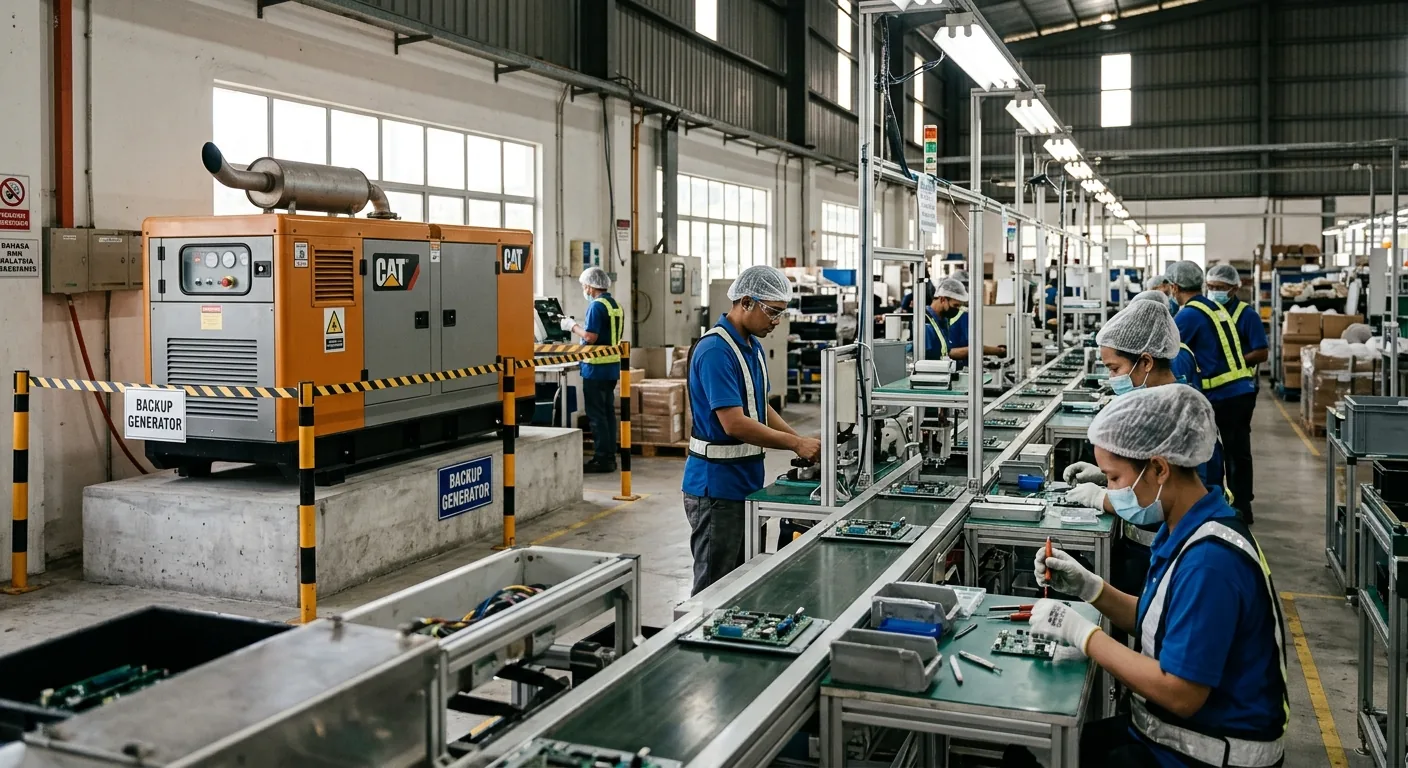
Genset rental for a data centre means a big-kVA diesel genset (usually 250kVA–500kVA+) that runs alongside a UPS for zero-downtime backup power. The UPS holds the load during the handover; the genset starts within seconds and carries the full load. It's configured in an N+1 setup and load-bank tested so a critical SLA never drops.
A data centre can't lose power for even a second — one trip means a breached SLA, downed servers, and angry clients. That's why a genset setup here is completely different from a typical event genset.
Why does a data centre need a specialised genset?
Because a data centre load is critical and runs 24/7 — power can't drop, and the genset has to carry the full load continuously, not in short bursts like an event genset.
Servers, cooling (HVAC), and networking are all voltage-sensitive. A small dip or spike can corrupt data or trip a server, so the genset has to deliver a stable, clean output.
On top of that, the genset has to stay on standby at all times and be ready to auto-start the moment the utility grid fails. It's this UPS + genset combination that delivers truly zero-downtime backup.
- Critical 24/7 load — no window for a shutdown
- Needs stable voltage output to protect servers & storage
- Auto-start (ATS) when the grid drops, with no one on-site
- Continuous standby duty, not a short prime run
How does a genset work with a UPS (zero-downtime)?
The UPS holds the load during the handover; the genset starts and takes over the load in just a few seconds.
When the utility grid drops, the UPS (battery) keeps power flowing instantly so the servers feel nothing. At the same time, the ATS (Automatic Transfer Switch) sends a start signal to the genset.
Once the genset is stable, the load is transferred from the UPS battery to the genset. The UPS is then recharged by the genset, so the system is always ready for the next round. This is the flow that delivers backup with no downtime.
- Grid drops → UPS instantly holds the load (battery)
- ATS sends signal → genset auto-starts within seconds
- Load shifts to genset once voltage & frequency are stable
- Genset recharges the UPS — ready for the next cycle
What is the N+1 concept for a data centre genset?
N+1 means you have one genset unit more than the actual load needs — if one unit fails, the remaining units can still carry the full load.
For example: if your load needs 2 gensets (N=2), an N+1 setup gives you 3 units. One unit can go down for servicing or a fault, but the data centre keeps running without interruption.
For a critical SLA (high uptime), N+1 is the baseline. The size and number of units depend on your load list — send us the load list and we'll arrange the right configuration. Get in touch for a quote.
- N = the number of gensets your load requires
- N+1 = add one redundant unit for safety
- One unit can go down (service/fault) without dropping the load
- Number of units follows the load list — confirm with us first
| Configuration | Meaning | Best for |
|---|---|---|
| N | Just enough gensets for the load | Minimum setup, no redundancy |
| N+1 | Add 1 redundant unit | Critical SLA / high uptime |
| 2N | Two full separate sets | Highest tier, maximum redundancy |
kVA sizing & load-bank testing — what you need to know
Data centres typically run big-kVA gensets — roughly 250kVA to 500kVA+, depending on the IT and cooling load — and every unit has to be load-bank tested before going on standby.
The actual size depends on the load list: servers, HVAC, lighting, and headroom for growth. Don't guess — send us the load list and we'll calculate the right estimate.
Load-bank testing confirms the genset can carry the full load without wet-stacking. This matters for a standby genset that rarely sees high load but must perform the moment the utility drops.
- Rough data centre estimate: 250kVA–500kVA+ (confirm with load list)
- Size follows IT load + cooling + growth headroom
- Load-bank test confirms the unit can carry the full load
- Avoids wet-stacking on a standby genset that's rarely full-load
- Our range is 20kVA–500kVA+ — big kVA available
| Data centre scale | Estimated kVA | Note |
|---|---|---|
| Server room / small edge | 60kVA–150kVA | Estimate — confirm load list |
| Mid-size data centre | 250kVA–400kVA | Estimate — confirm load list |
| Large data centre / N+1 | 500kVA+ (multiple units) | Estimate — confirm load list |
How much does a data centre genset rental cost?
There's no fixed price for a data centre — cost depends on several factors, and we quote based on your actual setup. Genset rental starts from RM300/day for a small unit, but a big-kVA data centre runs higher.
Key factors: kVA size, rental period, delivery & installation cost, diesel, and deposit. An N+1 setup with multiple units and load-bank testing also raises the cost compared to a single standalone unit.
That's why we don't publish a fixed price list for a critical setup — send us your load list, period, and location, and we'll reply with an accurate quote. Contact us for a quote.
- kVA size — big kVA = higher cost
- Rental period — daily, monthly, or long-term contract
- Delivery, installation & load-bank testing
- Diesel & deposit (refundable)
- Number of units (N+1 / 2N) — more units, more cost
| Cost factor | Effect on price |
|---|---|
| kVA size | Bigger kVA, higher rental |
| Period | A long contract is usually cheaper per day |
| Number of units | N+1 / 2N adds redundancy cost |
| Delivery & testing | Depends on location + load-bank requirement |
- Data centre genset = big kVA (roughly 250kVA–500kVA+) running alongside a UPS for zero-downtime.
- The UPS holds the load during the handover; the genset auto-starts (ATS) and takes over within seconds.
- The N+1 concept adds one redundant unit — one genset can go down without dropping the SLA.
- Load-bank testing is a must for a standby genset — it avoids wet-stacking and confirms full-load capacity.
- No fixed price: cost follows kVA, period, number of units, delivery & diesel — contact us for a quote.
- Actual sizing must follow your load list — don't guess, confirm with us first.
Contact Us Now — Reply Within 1 Hour
Genset rental for data centre — big kVA, works with UPS, N+1 redundancy, load-bank tested, zero-downtime. DOSH certified. WhatsApp us for a quote.
WhatsApp NowFAQ
Can a genset run a data centre without a UPS?
Not recommended for a critical load. There's a gap of a few seconds between the grid dropping and the genset stabilising — the UPS is what holds the load during that handover. Without a UPS, servers can trip or data can corrupt.
How fast does the genset start when the grid drops?
With an Automatic Transfer Switch (ATS), the genset auto-starts and takes over the load within just a few seconds. The UPS holds the load during this window so the transfer is truly zero-downtime for the servers.
Which kVA size suits my data centre?
It depends on the load list — IT load, cooling, and growth headroom. A rough data centre estimate is usually 250kVA–500kVA+, but don't guess. Send us the load list and we'll calculate the right size.
What is N+1 and why does a data centre need it?
N+1 means having one genset more than the load requires. If one unit fails or goes in for service, the remaining units still carry the full load. It's the baseline for a critical SLA / high uptime.
Are your gensets load-bank tested?
Yes — for a critical setup we provide load-bank testing so the unit is confirmed to carry the full load without wet-stacking. This matters for a standby genset that rarely sees high load but must perform when the utility drops.
How much does a data centre genset rental cost?
There's no fixed price — rental starts from RM300/day for a small unit, but big kVA and an N+1 setup run higher. Cost follows kVA, period, number of units, delivery and diesel. Contact us for an accurate quote.