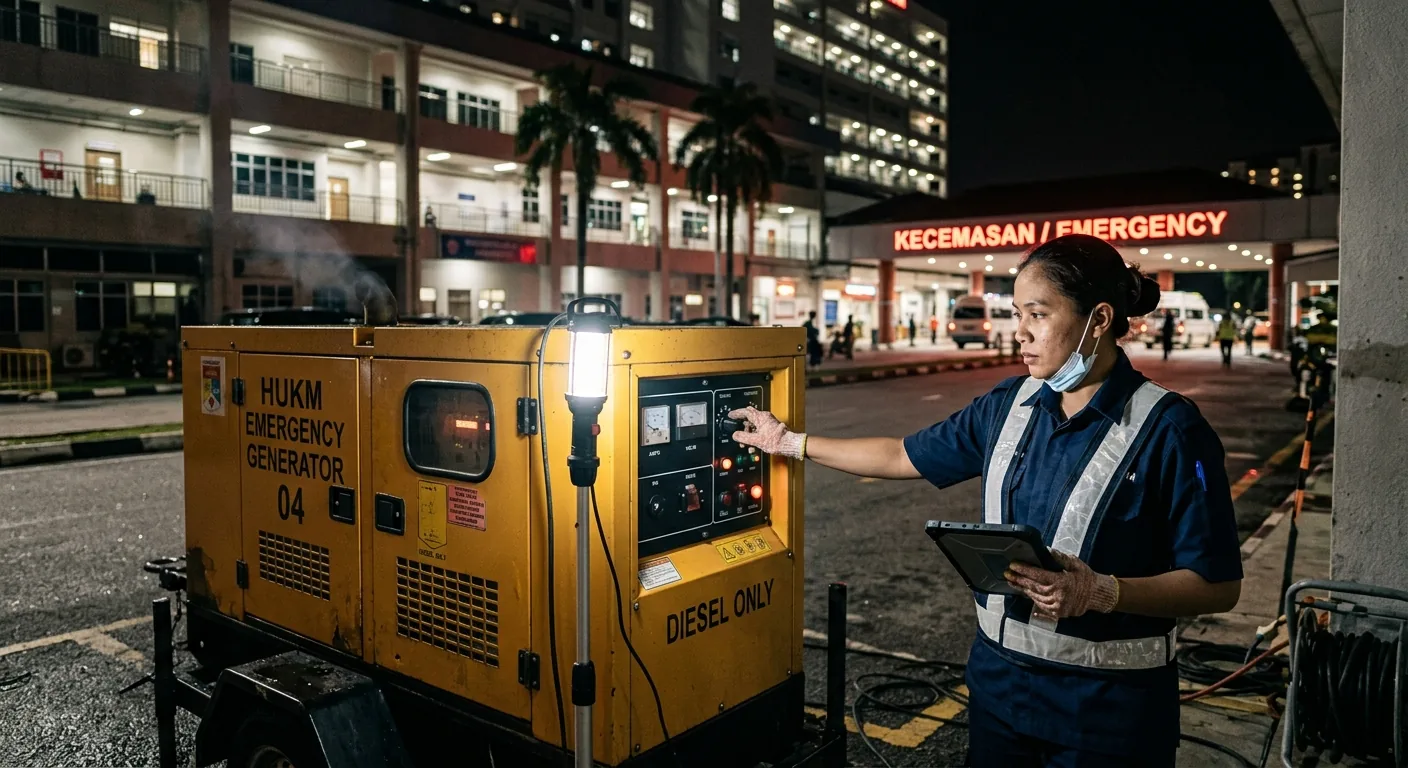
A rental genset gives hospitals critical power backup the moment the TNB grid drops — keeping ventilators, dialysis machines, vaccine cold storage and the ICU running without interruption. Choose a DOSH certified unit with fast transfer (ATS), sized to your facility's load list. Typical range is 20kVA–500kVA+, from RM300/day; contact us for an accurate quote.
For healthcare facilities, a blackout is not just an inconvenience — it can be a matter of life and death. That is exactly why a hospital genset has to be reliable, correctly sized, and compliant from day one.
Why do hospitals & clinics need a rental genset for backup?
A rental genset keeps critical equipment running the moment TNB supply drops, without the capital burden of buying a unit outright.
Healthcare facilities carry loads that simply cannot tolerate any gap — ventilators, dialysis machines, ICU monitors, and cold storage for vaccines and blood. Even a brief blackout can spoil stock or put patients at risk.
Renting gives you flexibility: scale the unit up or down as needs change, avoid long-term servicing costs, and get a standby unit quickly without a drawn-out procurement process. It suits everything from small clinics to large private hospitals.
- Life-support: ventilators, ICU, and operating theatres (OT) can have no power gap
- Cold chain: vaccines, blood, and lab samples need a stable temperature 24/7
- Diagnostics: x-ray, CT, and ultrasound machines are sensitive to unstable power
- Reputation & compliance: a backup failure can jeopardise a facility's licence
What genset size (kVA) suits a hospital or clinic?
The right size depends on your facility's total critical load — confirm it against a load list before locking in a unit.
A small clinic with a few basic items is usually fine with a smaller unit, while a hospital with an ICU, OT, and plenty of diagnostics needs far greater capacity. The figures below are estimates for an early picture only, not a final quote.
Don't undersize — a genset that is too small will overload and trip when every machine fires up at once. It is best to calculate the actual load plus a margin for motor startup and future expansion.
- Estimates only — confirm against your actual equipment load list
- Account for startup surge (compressors, motors), not just running load
- Build in a margin for future facility expansion
| Facility Type | Estimated kVA (not a quote) |
|---|---|
| Small clinic / panel clinic | 20kVA–60kVA |
| Large clinic / dialysis centre | 60kVA–150kVA |
| Mid-sized hospital / specialist centre | 150kVA–300kVA |
| Large hospital / multi-block | 300kVA–500kVA+ |
How does power transfer happen during a blackout?
With an Automatic Transfer Switch (ATS), the genset detects that TNB supply has dropped and takes over the load within seconds — no staff needed to start it manually.
For life-support loads that can tolerate no gap at all, an ATS is usually paired with a UPS — the UPS holds the load in the split seconds while the genset starts, and the genset then carries it for the long haul. This combo is standard for critical zones.
For facilities with less critical loads, a manual transfer is acceptable but relies on standby staff. We can advise which setup fits best based on your facility's risk profile.
- ATS = automatic transfer in seconds, no manual intervention
- UPS + genset = zero gap for ventilators, ICU, OT
- Manual changeover = a low-cost option for non-critical loads
When should a hospital rent a standby genset (rather than buy)?
A standby rental makes sense when the need is temporary, seasonal, or when you want to avoid capital and long-term maintenance costs.
Many facilities rent during main genset maintenance, expansion projects, or commissioning tests for a new building. When the built-in genset goes in for servicing, a rental unit ensures zero downtime for patient operations.
Renting also helps during peak season or when the area's grid is unstable. You get a correctly sized, DOSH certified unit with fast delivery — same-day in Peninsular Malaysia (Sabah/Sarawak/Labuan subject to availability).
- Main genset maintenance — avoid downtime during servicing
- Expansion / commissioning of a new block or ward
- Temporary backup when the area's grid is unstable
- Health events, mobile clinics, or outdoor setups
What determines the cost of a hospital genset rental?
Rental cost is not a fixed price — it moves with a few key factors, so every facility gets its own quote.
The biggest factors are kVA size and rental period — large units and short-term hires usually cost more per day. Delivery location, diesel, and the deposit all factor in too.
Rental starts from RM300/day for small units, but hospitals typically need large capacity with an ATS setup, so the most accurate approach is to request a quote based on your actual load and period.
- kVA size — the larger the unit, the higher the rate
- Rental period — daily, weekly, or monthly (long-term is cheaper per day)
- Delivery & location — drop-off/pick-up distance affects cost
- Diesel & deposit — usually separate from the base rental rate
- A hospital genset must back up critical loads: ventilators, ICU, OT, and vaccine/blood cold storage
- Choose a DOSH certified unit with an ATS for automatic transfer in seconds — add a UPS for zero gap
- Typical sizing runs 20kVA (clinics) to 500kVA+ (large hospitals) — always confirm against a load list
- A standby rental suits maintenance, expansion, or temporary backup without any capital cost
- Rental cost depends on kVA, period, delivery, diesel & deposit — from RM300/day; contact us for an accurate quote
Contact Us Now — Reply Within 1 Hour
Genset rental for hospitals & clinics — critical backup, fast transfer, standby during maintenance. 20kVA–500kVA+, DOSH certified. WhatsApp for a quote.
WhatsApp NowFAQ
Are rental gensets for hospitals DOSH certified?
Yes, our units are DOSH certified for commercial use and critical facilities. Compliance matters for hospitals because it ties directly to safety and operating licences. Contact us to confirm exactly which documents you need.
How fast can a genset be delivered in an emergency?
For Peninsular Malaysia, we offer same-day delivery subject to unit availability. Sabah, Sarawak, and Labuan follow local availability. WhatsApp us right away for emergencies so we can arrange the fastest possible delivery.
What kVA size do I need for my clinic?
It depends on the equipment you want to back up — a small clinic typically falls in the 20kVA–60kVA estimate. That figure is an early guide only; the most accurate way is to send your equipment load list so we can calculate the real size.
Can a genset handle sensitive diagnostic equipment?
Yes, as long as the unit is correctly sized and fitted with a stable power setup. For sensitive machines like x-ray or CT, we recommend a genset paired with an ATS and UPS to avoid interruptions. Tell us your equipment for a precise recommendation.
How much does a genset rental for a hospital cost?
There is no fixed price because it depends on kVA size, rental period, delivery, diesel, and deposit. Rental starts from RM300/day for small units, but hospitals usually need larger capacity. Contact us for a quote based on your actual needs.
Can I rent a genset only during main genset maintenance?
Yes, and this is one of the most common use cases. We provide a standby unit for the whole period your built-in genset is being serviced, so there is no downtime for patient operations. Rental can be daily, weekly, or monthly to suit your needs.