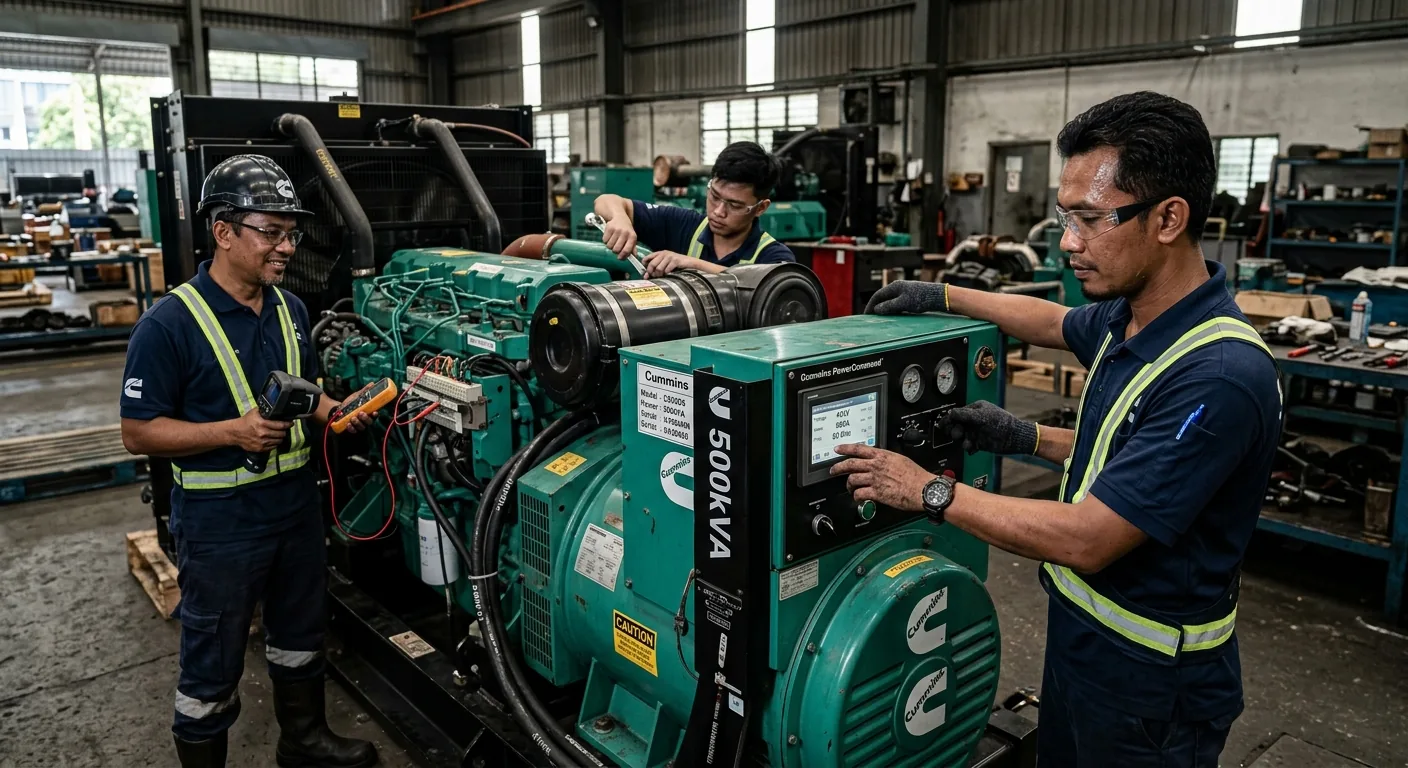
To match genset kVA size to your load: the 20–60kVA tier suits shops, homes, and small events; 100–200kVA fits mid-size factories, construction sites, and large offices; 250–500kVA+ covers heavy industry and plants. Add up the load (kW) of all equipment, add a 20–30% starting-load margin, then map it to the right kVA tier.
Pick the wrong size and the genset trips, or you burn extra money. Matching kVA to your actual load — not guesswork — is what keeps rental costs down and downtime away.
How do you calculate genset kVA size by load?
Add up the power (kW) of every appliance you'll run at the same time, add a starting-load margin, then convert to kVA. That's the most accurate way to match the size.
Gensets are rated in kVA, but your equipment is labelled in kW or amperes. The rough conversion: kVA = kW ÷ 0.8 (typical power factor). So a load of 80kW roughly needs a 100kVA genset.
Never run a genset at full 100% — let it work at around 70–80% capacity. That extra headroom prevents overheating, extends engine life, and absorbs brief load surges.
- List every appliance + power (kW) running at the same time
- Add them up to get the total continuous (running) load
- Add 20–30% for starting load (motors, compressors, air-cond)
- Convert kW → kVA (divide by power factor ~0.8)
- Choose a kVA tier that gives headroom, not one that's cutting it close
| Step | Example |
|---|---|
| Total running load | 60 kW |
| Add 25% margin | 75 kW |
| Convert to kVA (÷0.8) | ~94 kVA |
| Recommended tier | 100 kVA |
Tier 20–60kVA: what loads is it for?
The 20–60kVA tier suits light loads — retail shops, homes, small offices, events, and booths.
In this range, it's usually enough for lights, fans, a few split air-cond units, a fridge, POS systems, and small kitchen equipment. It's portable and the cheapest to rent, starting from RM300/day (estimate — contact us for a quote).
Watch out for air-cond units and compressors in this tier — their starting load can spike to 2–3 times the running watts. Even small loads need margin so the genset doesn't trip when a motor kicks in.
- Retail shops, mamak stalls, salons, small clinics
- Homes / standby when TNB supply is cut
- Small events, exhibition booths, kenduri
- Small worksites — tools, lights, small pumps
| Load type | Estimated kVA |
|---|---|
| Home / small shop | 20–30 kVA |
| Small office + air-cond | 30–45 kVA |
| Event / booth | 20–60 kVA |
Tier 100–200kVA: what loads is it for?
The 100–200kVA tier fits medium-to-large loads — small factories, construction sites, large offices, and big events.
In this range it can typically carry several production machines, a centralised air-cond system, a small tower crane, large pumps, and many air-conditioning units running at once. It's the most common pick for commercial projects and light industry.
Loads with many large motors (compressors, pumps, conveyors) often start at the same time — don't size it too tight. Give enough headroom so the starting surge doesn't trip the genset or cause a voltage drop.
- Small-to-mid factories, large workshops
- Construction sites — cranes, mixers, pumps, hoists
- Large offices / commercial buildings
- Big events — concerts, festivals, exhibitions
| Load type | Estimated kVA |
|---|---|
| Mid-size construction site | 100–150 kVA |
| Light factory | 150–200 kVA |
| Large commercial building | 100–200 kVA |
Tier 250–500kVA+: what loads is it for?
The 250–500kVA+ tier is for heavy loads — processing industries, plants, data centres, and mega projects.
This range carries heavy machinery, large HVAC systems, banks of lifts, and critical loads that can't go down. For even bigger loads, several units can be synchronised so capacity scales up and you get redundancy if one unit needs servicing.
At this size, planning has to be precise — ventilation, diesel storage, and cable layout are all critical. This is no place for guesswork; an accurate load list must be reviewed first.
- Heavy factories, processing plants, foundries
- Data centres, hospitals, critical loads
- Infrastructure / large mega projects
- Primary standby for high-rise buildings
| Load type | Estimated kVA |
|---|---|
| Heavy industry | 250–400 kVA |
| Plant / critical load | 300–500 kVA |
| Mega project (multi-unit) | 500 kVA+ |
Why does starting load matter when choosing a size?
Starting load (the power surge when a motor kicks in) can be 2–6 times the running watts — ignore it, and the genset trips even when the size looks adequate.
Equipment with motors — air-cond, compressors, pumps, lifts, conveyors — draws a big current for a moment at start-up. A genset sized only on running load will struggle when these loads switch on together.
That's why we always add margin and ask for a full load list. Tell us the type and number of motors, and we'll match the right kVA tier and avoid undersizing.
- Air-cond / compressor: starting ~2–3× running watts
- Pumps & lifts: surge can hit 3–6× for a moment
- Many motors starting at once = high load peak
- 20–30% margin is typical; heavy motor loads need more
| Equipment type | Estimated starting load |
|---|---|
| Lights / heaters | ~1× running (no surge) |
| Air-cond / compressor | ~2–3× running |
| Pump / large motor / lift | ~3–6× running |
- Size by load: total kW + starting margin, then convert to kVA — not guesswork.
- 20–60kVA for homes, shops, small events; 100–200kVA for factories & construction sites; 250–500kVA+ for heavy industry.
- Let the genset run at 70–80% capacity — don't rate it full, give it headroom.
- Motor starting load can be 2–6× the running watts; add a 20–30% margin so the genset doesn't trip.
- Every kVA range here is an estimate — confirm with a real load list for an accurate quote.
Contact Us Now — Reply Within 1 Hour
Match genset kVA size to your load: tiers 20–60, 100–200, 250–500kVA+ for every load type. Contact PowerRent for an accurate sizing quote.
WhatsApp NowFAQ
How do you convert kW to kVA when choosing a genset?
Divide the kW power by the typical power factor of 0.8 — so 80kW is roughly 100kVA. Then add a starting-load margin and pick a kVA tier that gives headroom, not one that's cutting it close.
Which kVA size suits a home or small shop?
Usually the 20–60kVA tier is enough for a home, retail shop, or small office. If you have several air-cond units, lean towards 30–45kVA to handle the starting load. Confirm with your equipment list.
Which kVA size for a construction site or factory?
Construction sites and mid-size factories typically use the 100–200kVA tier depending on machinery. Heavy industry and plants fall in the 250–500kVA+ range. Give us your machine list for an accurate match.
What happens if the genset size is too small?
An undersized genset will trip, drop voltage, and damage sensitive equipment. It also overheats and wears out fast when forced beyond its capacity. It's safer to give enough margin from the start.
Can I just take a bigger genset to be safe?
Over-sizing too much wastes rental and diesel money, and running too low a load can cause wet stacking in a diesel engine. The sweet spot is a genset working at around 70–80% capacity. An accurate match saves more.
Why do you ask for the load list first?
Because the running load and starting load determine the right kVA tier — especially when there are many motors. A full load list avoids both undersizing and oversizing. Contact us for a review and a properly matched sizing quote.